
Decoating Furnaces in Europe: Two Markets, One Decision Logic
Decoating splits into two distinct purchases: cleaning used beverage cans and coated scrap before melting, and stripping paint from hooks and fixtures. The suppliers differ, but the decision logic, feed, coating, temperature and emissions, is the same.
A decoating furnace is bought for one of two reasons: to protect metal yield before melting, or to restore coating hardware for reuse. This briefing maps both European markets, the suppliers and the questions that stop a furnace from being specified in a way the site cannot operate.
Two markets, one logic
Market A is used beverage can and coated aluminium scrap decoating before melting. The value sits in metal yield: removing lacquer under controlled low-oxygen heating keeps the coating from burning inside the melt furnace, where it would become dross and complicate the off-gas. Market B is hook, fixture and industrial part burn-off, where the value sits in restoring coating hardware for reuse. Both are specified by feed, coating chemistry, temperature window and the off-gas interface, even though the buyers rarely overlap.
Who buys a decoating furnace
| Buyer segment | What they need | Purchase trigger |
|---|---|---|
| Secondary aluminium smelters and UBC recyclers | Continuous decoating before melting to cut melt loss and dross | High melt loss, dross load and emission limits |
| Aluminium rollers and can sheet producers | Decoating and melting integrated into recycled-content sheet | Recycled content and carbon targets |
| Canmakers | Closed-loop UBC recovery through their sheet and smelting partners | Recycled content commitments |
| Coating lines and paint shops | Burn-off ovens to strip hooks, fixtures and reject parts | Hook build-up and replacement cost |
| Thermal cleaning service providers | Oven capacity to sell cleaning as a service | Regional cleaning demand |
Competitor landscape
In market A, Hertwich Engineering, part of SMS group, combines UBC decoating with its Ecomelt multi-chamber melting furnace so decoated material is immersed directly into the melt. The Italian IDEX system offers continuous decoating and drying from 500 kg/h up to 20 t/h across UBC, profiles, litho sheet, caps and foil, and Nabertherm supplies the thermal treatment furnaces used in many process trials. YUSHUNXIN competes in this space with its UBC and coated-scrap decoating lines.
In market B, the field is Belgian, German and Italian. Arena Comet builds pyrolysis ovens and fluidised beds, Pyrox builds low-oxygen cleaning ovens, WIWOX supplies large-batch paint stripping furnaces, For.Tec builds burn-off chamber ovens for hooks and reject parts, and Merich AG supplies firing and thermal cleaning ovens. These are batch machines, specified around part size, weight, temperature limit and coating load.
| Supplier | Country | Position |
|---|---|---|
| Hertwich Engineering (SMS group) | Austria | UBC decoating integrated with Ecomelt melting |
| IDEX (Gefond / Insertec) | Italy | Continuous decoating and drying, 500 kg/h to 20 t/h |
| Arena Comet | Belgium | Pyrolysis ovens and fluidised beds for thermal cleaning |
| Pyrox | Belgium | Low-oxygen thermal cleaning ovens |
| WIWOX / For.Tec | Germany / Italy | Paint stripping and burn-off furnaces for hooks and parts |
The questions that make furnace bids comparable
- Feed - UBC, coated scrap or coating hardware, and the arrival form
- Coating - paint, lacquer or powder chemistry, including any halogen content
- Throughput or batch envelope - tonnes per hour, or part size and load weight
- Temperature and residence - the window the coating and the part can tolerate
- Energy - whether the coating volatiles can be recirculated as fuel
- Emission basis - the off-gas and permit interface the site must meet
Where YUSHUNXIN fits
The UBC decoating line is confirmed at 2 to 8 tonnes per hour on a continuous rotary drum with UBC metal burn loss below 0.5%, and coated aluminium scrap at 1.5 to 6 tonnes per hour with three-stage PID control from 400 to 540 degrees Celsius. The furnace and its off-gas are supplied as one system, because splitting them across suppliers leaves the interfaces to be resolved on site, where changes cost the most.
Decoating market FAQ
Why are UBC decoating and hook burn-off different markets?
UBC decoating protects metal yield before melting and is specified by coating load and tonnes per hour, while hook and fixture burn-off restores coating hardware and is specified by part size, weight and temperature limit. The suppliers and buyers are mostly separate.
Can one furnace do both?
Rarely well. A continuous UBC drum and a batch burn-off oven are different duties, and mixing them into one specification usually compromises both. Each feed is specified separately.
Does the off-gas belong in the furnace scope?
Yes. The furnace and its gas handling are one system, and sizing them together is the only way to know the recirculation loop, thermal oxidation duty and permit interface agree.
Related reading
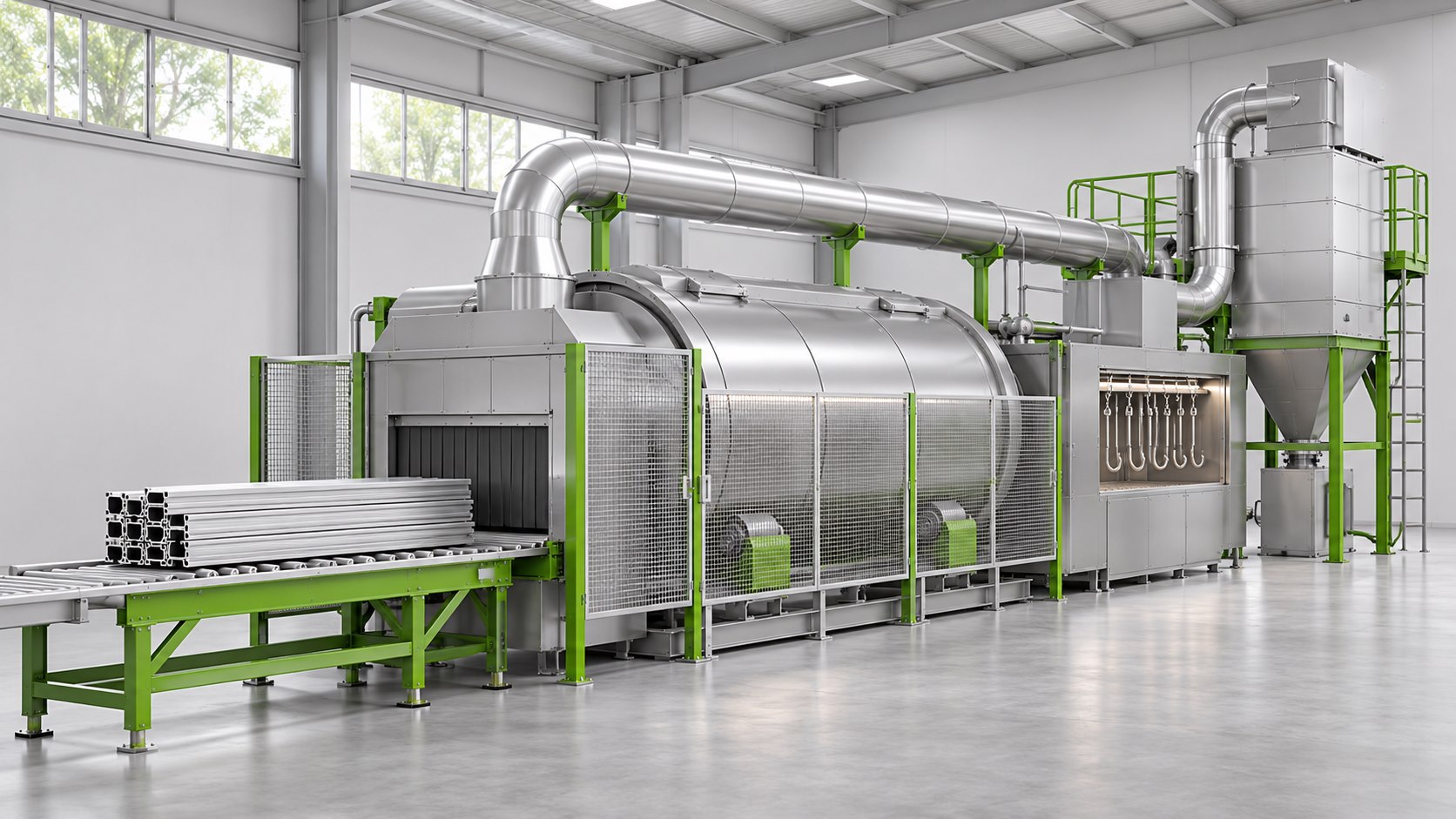
Thermal Decoating & Cleaning
The board covering UBC, coated scrap, hooks and industrial parts.
Aluminium Decoating: Energy and Emissions
Why decoating before melting wins and how the energy loop is engineered.
UBC Decoating Furnace: Buying Questions
Feed, coating, burn loss, energy and emission questions to ask first.