
PV Manufacturing Scrap Recycling
Production residues handled by composition and condition so recoverable fractions are not lost in a mixed waste stream.
Manufacturing scrap arrives as off-spec cells, lamination cut-offs and rejected modules. The route is selected by composition and contamination.
Scrap is not one stream
Cell offcuts, lamination rejects and broken modules carry different values and different handling risks. Cell offcuts are rich in silicon and silver but delicate, while lamination rejects still carry the encapsulant and glass. Keeping the streams separate at source protects the copper, silicon and glass fractions that a mixed stream would lose.
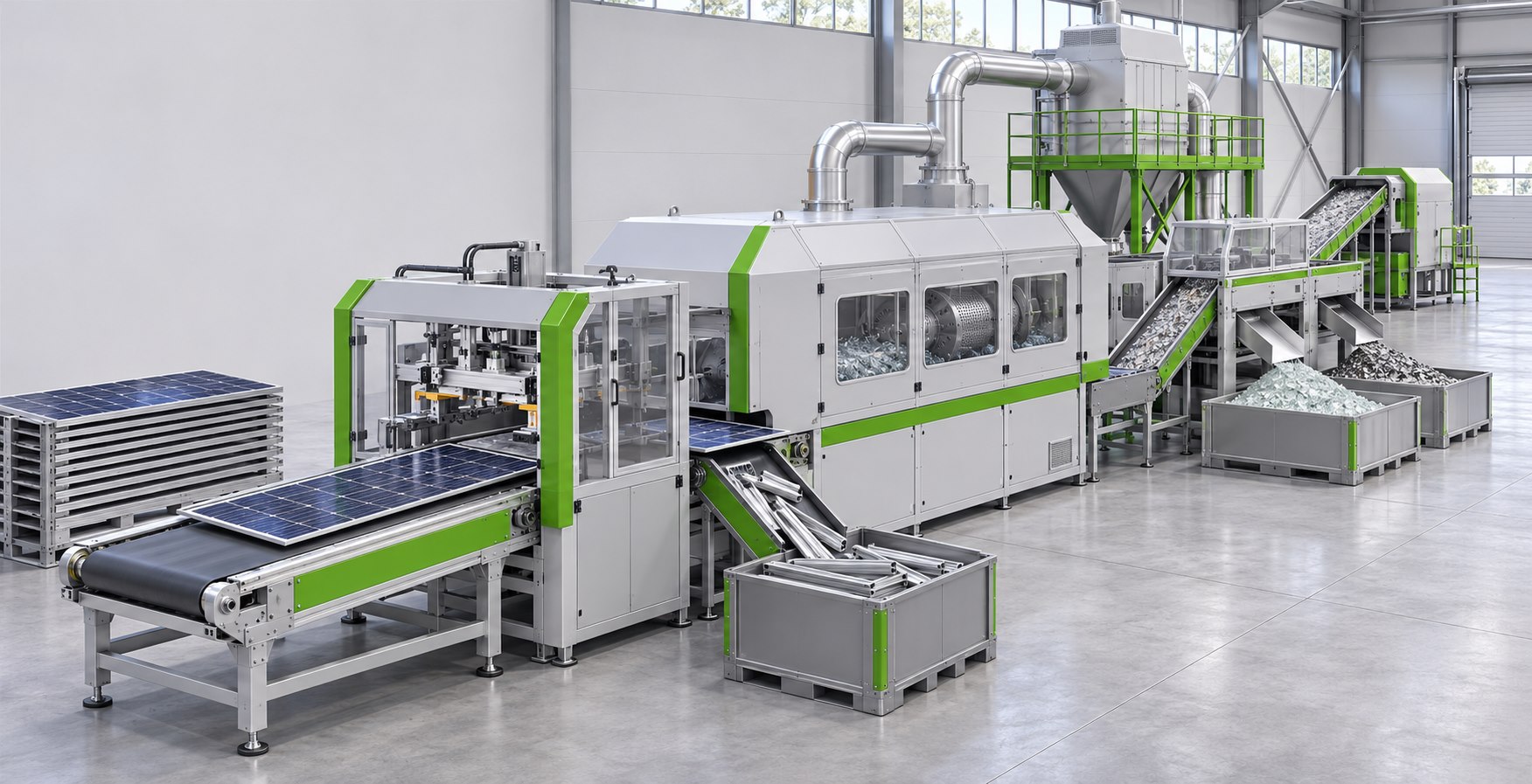
Typical route for production residues
Classification
Scrap grouped by composition and contamination.
Pre-treatment
Frames and boxes removed where present.
Separation
Glass, copper and silicon-bearing fractions produced.
Because manufacturing scrap is usually cleaner and more homogeneous than end-of-life modules, the route can be leaner, but the residual value still depends on keeping the fractions separated. A factory that segregates its scrap upstream gets a better recovery result than one that bales everything together.
What we need from you
- Scrap type and composition
- Physical form and moisture
- Contamination and packaging
- Target throughput and output fractions
PV manufacturing scrap FAQ
Why keep scrap streams separate at source?
Cell offcuts, lamination rejects and broken modules carry different values and risks. Segregating them at source protects the copper, silicon and glass fractions that a mixed stream would lose, and it lets a leaner route recover more value.
Is manufacturing scrap easier to process than end-of-life modules?
It is usually cleaner and more homogeneous, so the front end can be leaner, but residual value still depends on keeping the fractions separated and on declaring the physical form and contamination before the route is fixed.
The value case for manufacturing scrap is different from end-of-life modules. The material is cleaner and more homogeneous, so the route can be leaner, but the real saving comes from recovering the copper, silicon and glass before they are diluted in a mixed waste stream. A factory that segregates its scrap upstream and sends the composition with the enquiry gets a route that matches its actual residues, not a generic PV line adapted after the fact. The cleaner feed also means the recovered fractions can meet tighter buyers' specifications, which is where the margin sits.
A factory that documents its scrap types can also track how the recovery changes over time, which is the first step toward a steady, measurable return from the line.