
End-of-Life Cell & Module Recycling
Spent cells, modules and packs handled by format, chemistry and residual charge to recover black mass and metals.
End-of-life batteries arrive in many formats and states. The route starts from the actual feedstock and the safety basis the site can operate under.
Format and chemistry drive the design
Packs must be dismantled or pre-processed before cells are reduced. Cylindrical, prismatic and pouch cells respond differently, and residual charge changes the discharge requirement and the shredding safety measures. NCM and LFP also route differently because the value concentrates in different fractions, which is why chemistry, format and state of charge are specification inputs.
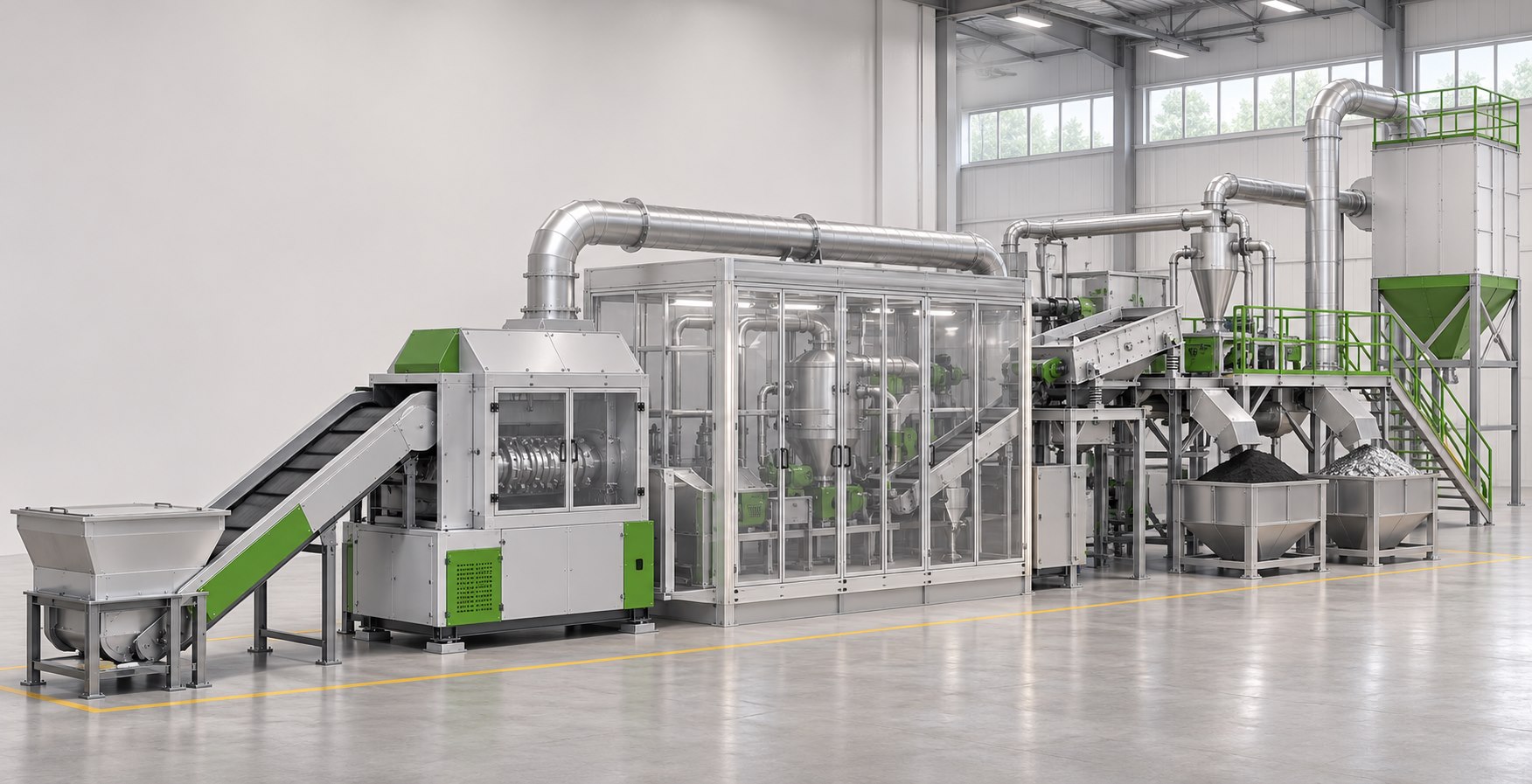
Typical route from pack to fractions
Pre-treatment
Packs discharged and prepared.
Shredding
Cells and modules reduced under control.
Separation
Black mass, copper and aluminium produced.
The route is dry and physical, with no wastewater discharge. The inerting and dust controls are part of the design, so the plant can handle the energy-release and combustible-dust risks of real spent batteries.
What we need from you
- Cell or module format and chemistry
- Residual charge and condition
- Packaging and transport constraints
- Target throughput and output fractions
End-of-life battery FAQ
How do format and chemistry change the route?
Packs must be dismantled or pre-processed before cells are reduced, and cylindrical, prismatic and pouch cells respond differently. NCM and LFP also route differently because value concentrates in different fractions, so format, chemistry and state of charge are specification inputs.
Is the process dry?
Yes. The route is dry and physical with no wastewater discharge, and the inerting and dust controls are part of the design so the plant handles the energy-release and combustible-dust risks of real spent batteries.
The front end is where most of the project risk sits. Packs have to be discharged and prepared before the cells are reduced, and the preparation differs by format and state of charge. A route that skips this step to save capital simply moves the risk into the shredder, where it becomes a safety problem instead of a process step. Specifying the pre-treatment together with the shredding and separation is what keeps the whole line safe and the fractions clean. The same pre-treatment also protects the separation train from damage and contamination.
The output targets then finish the route, because the black mass, copper and aluminium have to meet the refiner's acceptance limits rather than a generic purity number.
The route is supplied with nitrogen inerting where the feed needs it, with the plant built at the 25,000 m2 manufacturing base in Henan, China against the confirmed ISO9001, CE and EPA Compliant basis and the motor voltage matched to the site's 380, 480 or 600 V supply.