Lithium Battery Recycling: A Procurement Guide by Buyer Type
A black mass producer, a refiner, a gigafactory and a waste group buy different battery recycling decisions. This guide matches each to its commercial trigger and the criteria that make the line safe, saleable and defensible.
Battery recycling is bought for one of four reasons, and the reason sets the specification. This guide maps each buyer type to its procurement judgment, so the line is specified against the feed and the refiner, not against a headline capacity.
Find your buyer type
| Buyer type | What you care about most | Commercial trigger |
|---|---|---|
| Black mass producer | Separation quality and black mass saleability | EU Battery Regulation treatment duties |
| Refiner (hydro or pyro) | Consistent feed with low copper and aluminium | Feed security and expansion |
| Gigafactory / carmaker | Scrap handling and take-back documentation | Production scrap and supply-chain duties |
| Waste group / EPC | Whole-line scope, safety and fire interfaces | Regional treatment capacity |
The six procurement judgments every battery buyer must make
- Chemistry - LFP, NMC or a defined mix, because it changes safety and separation design
- Format and condition - pouch, prismatic or cylindrical, scrap or end-of-life with residual charge
- Discharge and inerting - how residual energy is managed before reduction and the oxygen limit in the critical chamber
- Target fractions - black mass, copper and aluminium against the refiner's acceptance specification
- Safety and fire basis - dust, inerting and the fire interfaces the site can operate
- Scope and evidence - where supply starts and ends, and what test records prove the output
Match your criteria to the questions
The question that matters changes with your buyer type. Send the matching question early, and require the answer in writing, because it is the difference between a line that is specified and a line that is sold.
| Buyer type | Priority criterion | Question to ask suppliers |
|---|---|---|
| Black mass producer | Black mass quality | What is the black mass quality your line is tested against, and which refiner acceptance spec does it meet? |
| Refiner | Feed consistency | How do you hold copper and aluminium contamination within my acceptance limits across feed variation? |
| Gigafactory / carmaker | Safety and documentation | What is the discharge and inerting basis for our specific cell chemistry and state of charge? |
| Waste group / EPC | Scope and interfaces | Where exactly does your supply scope start and end, and who owns the fire and dust interfaces? |
Where YUSHUNXIN fits
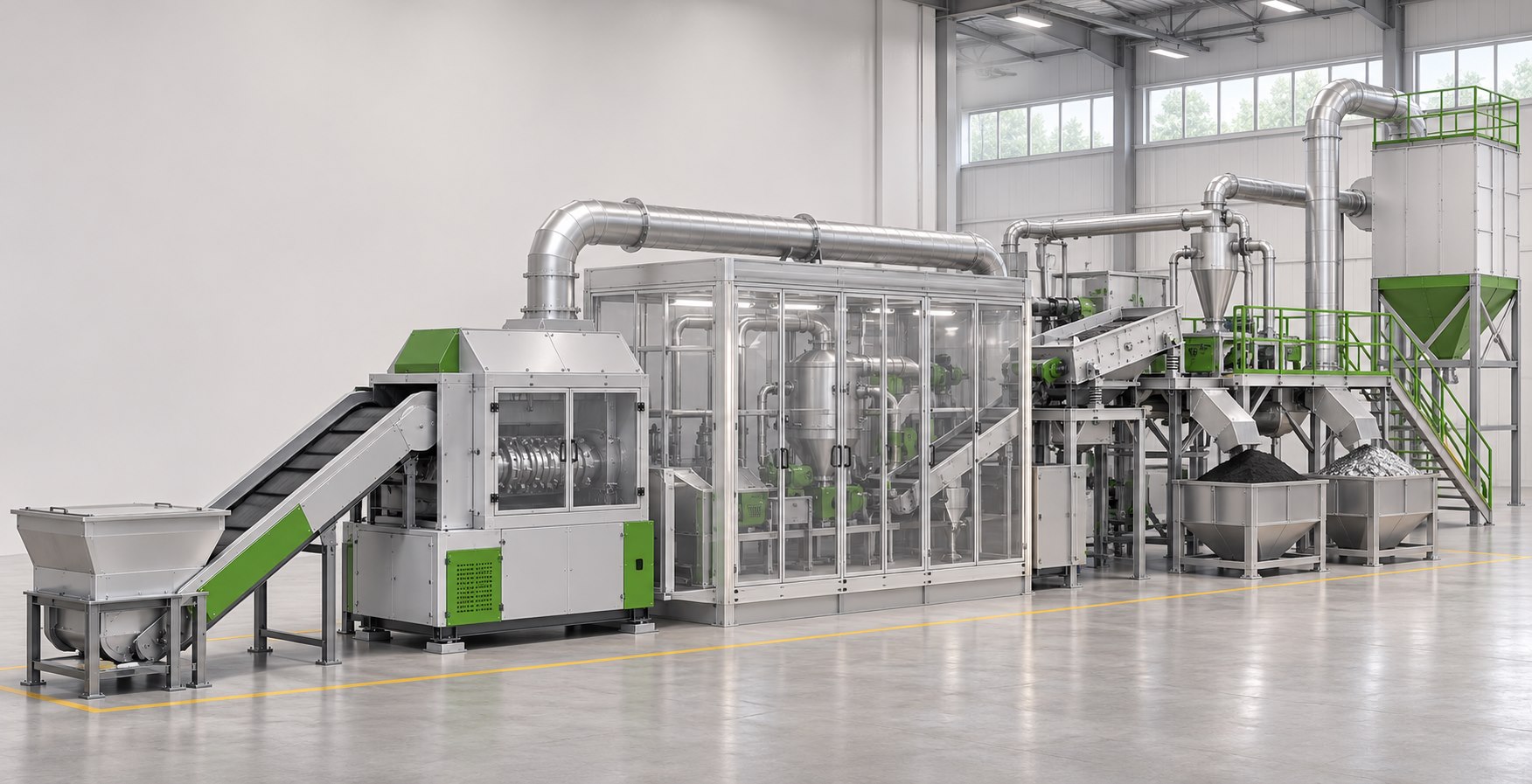
The ENV-SOL-LFP battery recycling solution is confirmed for 500 to 3,000 kg/h of cell feed with nitrogen inerting below 3% oxygen and black mass from 95% upwards, with the final configuration set by the feed and target fractions above. The dry physical route separates black mass, copper and aluminium without wastewater discharge, and the equipment boundary is stated against the operator's own compliance responsibility.
Battery procurement guide FAQ
Which judgment is most often skipped?
The refiner's acceptance specification. Buyers fix a purity number without the document the refiner will actually measure against, then rework the separation train. Fix the acceptance spec before the black mass target.
Turnkey line or integrate separate machines?
A turnkey line keeps the discharge, shredding and separation interfaces under one scope and one safety basis. Integrating separate machines shifts the interface risk onto you, which is expensive to fix on site.
How do I know the line will stay compliant?
Specify it against the feed and the recovered fractions, not a single machine. A route built this way is easier to document as requirements tighten, because the evidence trail is in the design.