PV Module Recycling in Europe: Buyers, Competitors and What to Ask
The European PV recycling market is small but growing fast, driven by WEEE treatment duties and the decommissioning wave. The practical decision is mechanical versus thermal, and the choice follows the module mix and the fractions the business must sell.
Photovoltaic module recycling has moved from a niche stream to a regulated treatment category in Europe. This briefing maps the market, the buyer segments and the equipment suppliers, then reduces the decision to the questions that make competing quotations comparable.
Market shape and growth
Published estimates differ because they draw different boundaries, but they agree on direction. One research summary values the European solar panel recycling market at about USD 144 million in 2025, reaching roughly USD 426 million by 2032 at a 14.7% compound annual rate. Another sizes it at about USD 163 million in 2025 and USD 310 million by 2031, an 11.5% annual rate. Both describe a small, fast-growing market led by decommissioning volumes and WEEE treatment duties.
| Source | 2025 estimate | Projection | CAGR |
|---|---|---|---|
| 24chemicalresearch (report 281957) | USD 143.8 million | USD 425.9 million by 2032 | 14.7% |
| GII / ResearchAndMarkets | USD 162.9 million | USD 310.2 million by 2031 | 11.5% |
Regulation sets the floor
Under WEEE 2012/19/EU, photovoltaic modules are treated as electrical equipment, which brings collection, treatment and recovery obligations into member-state systems. France's producer responsibility organisation Soren reported collecting 13,760 tonnes of PV panels in 2025, up substantially on 2024, and PV CYCLE Italia managed about 5,273 tonnes in 2025. These figures matter because they show the flow is real and already contracted, not theoretical.
Who buys a PV recycling line
| Buyer segment | What they need | Purchase trigger |
|---|---|---|
| Specialist PV recyclers | Frame and junction-box removal, glass release, crushing and separation | Rising module volumes and treatment contracts |
| WEEE operators | A PV stream that plugs into existing e-waste handling | New permits and PRO treatment contracts |
| Solar park owners and EPCs | Bulk decommissioning with material monetisation | Repowering and end-of-life projects |
| Module manufacturers | Recovery of production scrap and off-spec cells | Factory scrap cost and take-back duties |
Competitor landscape
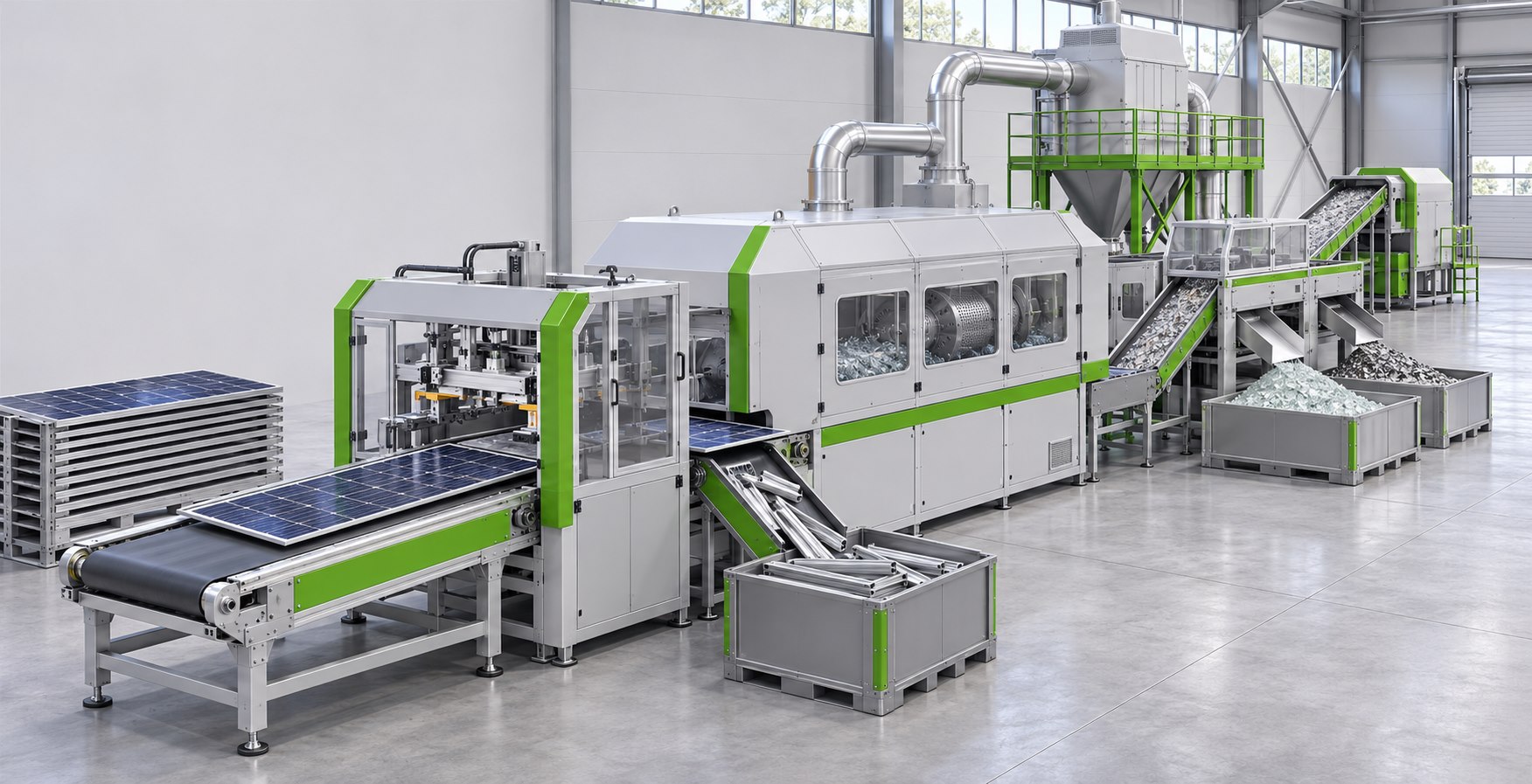
On the equipment side, Ecoprogetti in Italy has moved furthest into automated module recycling: pv magazine reported in November 2026 that its line at the Haiki+ facility in Sale, Italy, processes up to 120 panels per hour, about four tonnes, at 94% uptime with three operators. Reiling created Convitrum GmbH in March 2026 as a dedicated PV-recycling plant engineering firm, and Italian builders such as Tecno Costruzioni and Forrec supply PV panel mechanical lines and shredders. Alongside these sit the Chinese equipment makers, including YUSHUNXIN, that compete on project scope and emission basis.
| Supplier | Country | Position |
|---|---|---|
| Ecoprogetti | Italy | Automated PV module recycling line (HORIZON series) |
| Convitrum GmbH | Germany | PV-recycling plant engineering founded by Reiling |
| Tecno Costruzioni | Italy | Mechanical PV panel recycling lines |
| Forrec | Italy | Industrial shredders covering PV module streams |
The recycling operators themselves are a second competitive force, because several develop their own process knowledge rather than buying turnkey lines. Veolia has run a PV recycling centre in Rousset, France since 2018; Reiling opened a Münster centre in 2023; ROSI Solar in France pursues high-purity silicon and silver recovery; SOLAR MATERIALS reports about 14,000 tonnes a year of German module recycling capacity after a 2025 expansion; and LuxChemtech and Tialpi add German and Italian treatment capacity.
The questions that make bids comparable
- Module mix - framed single-glass, double-glass or frameless, and glass thickness
- Condition - share of damaged, contaminated or mixed modules
- Target fractions - aluminium, glass, copper and the cell fraction quality required
- Route - mechanical versus thermal, and whether the site can permit a thermal stage
- Emission basis - dust and off-gas interfaces the site can actually operate
Where YUSHUNXIN fits
YUSHUNXIN Environmental supplies the European project entry and route decision for PV, while the deep equipment catalogue and confirmed specifications live on the dedicated PV site. The honest split keeps this page on the market and decision level, and points the reader to the equipment detail only after the route is fixed.
PV market FAQ
Mechanical or thermal route for European modules?
The choice follows the module mix and the fractions you must sell, not the regulation alone. Framed single-glass, double-glass and frameless modules behave differently, and a plant that may add a thermal stage later should confirm the site permit now, even if it starts mechanical.
Are the market figures precise?
No. Estimates range from roughly USD 144 million to USD 163 million for 2025 because sources draw different boundaries. The direction and the drivers, WEEE duties and decommissioning, are the robust part of the picture.
Who are the real competitors to an equipment buyer?
European turnkey and line builders such as Ecoprogetti and Convitrum, Italian shredder and line makers, and Chinese equipment suppliers. Recycling operators that build their own process are also a competitive route for some projects.